South Africa Has No Shortage of Young Entrepreneurs. So Why Is Opportunity Still Out of Reach?

The institutions exist. The funding instruments exist. The opportunities exist. So why are so many young South African entrepreneurs still struggling to get their businesses off the ground?
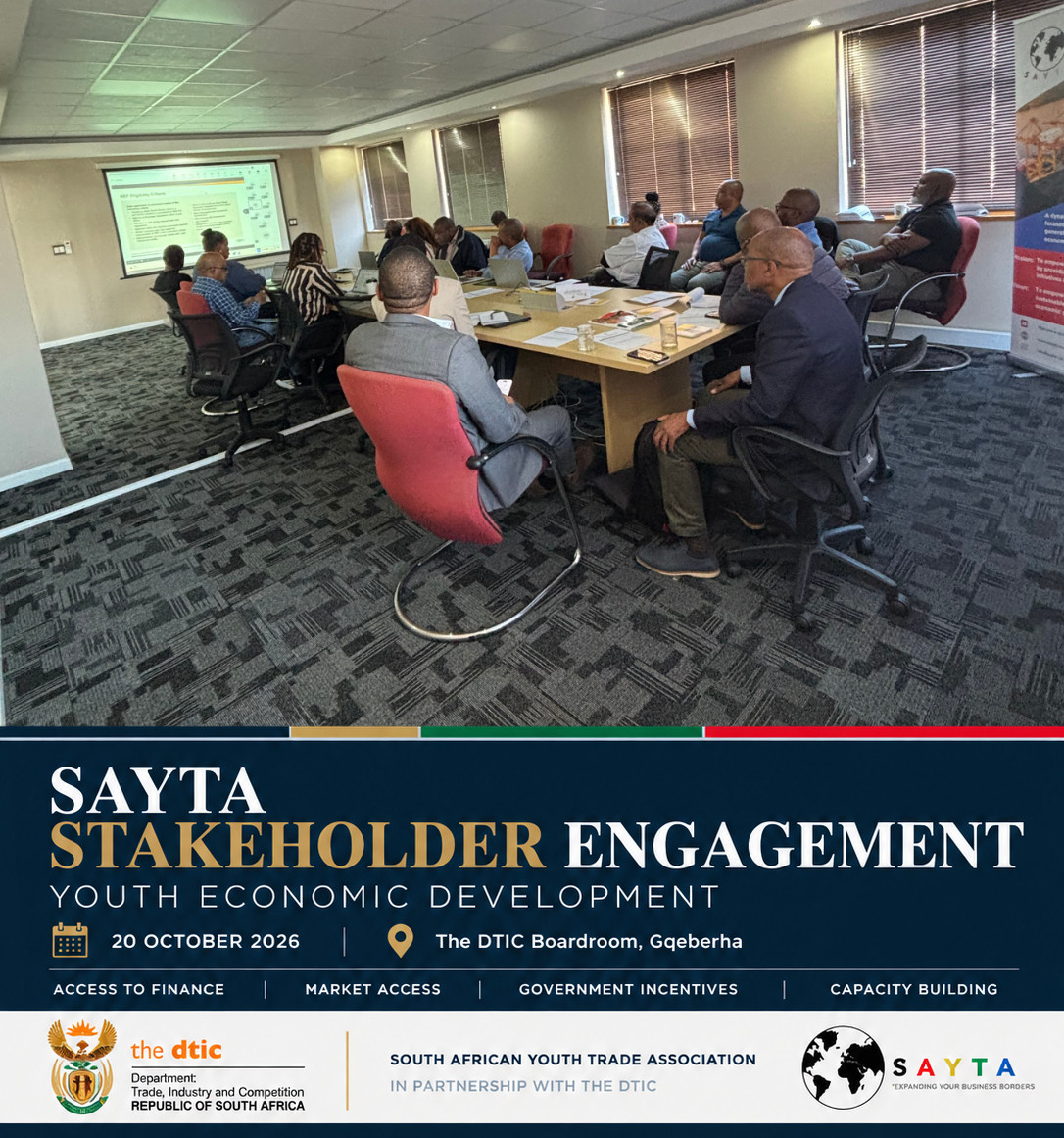
That question was at the heart of a stakeholder engagement convened by the South African Youth Trade Association (SAYTA) at the Department of Trade, Industry and Competition (the dtic) Boardroom in Gqeberha.
The session brought together representatives from government, development finance institutions and the broader business development ecosystem to explore a familiar challenge: South Africa isn't short on entrepreneurial ambition. It's struggling to turn that ambition into commercially competitive businesses.
And while access to finance remains critical, the discussions revealed a bigger picture. From small-scale mining and agricultural aggregation to investment readiness and automotive manufacturing, entrepreneurs face different barriers that often require the same solution: coordinated institutional support.
The Big Picture: Opportunity Without Access Isn't Opportunity
Consider this.
A young miner identifies a promising mineral deposit but cannot afford geological assessments. An agricultural entrepreneur secures a potential buyer but lacks the production capacity to fulfil the order. A manufacturing startup has the technical expertise but struggles to enter established automotive supply chains.
Different sectors. Different barriers. Same underlying problem.
The gap between identifying an opportunity and building a commercially sustainable enterprise remains significant.
Several institutions contributed perspectives on how to bridge that gap. Among the contributions captured from the engagement were insights from the Department of Mineral and Petroleum Resources (DMPR), Industrial Development Corporation (IDC), National Empowerment Fund (NEF) and Nelson Mandela Bay Municipality's Economic Development, Tourism and Agriculture Directorate (NMBM EDTA).
Here's what stood out.
⛏️ DMPR: Finding Minerals Is One Thing. Building a Mining Business Is Another.
South Africa's mineral wealth presents significant opportunities, but emerging miners face steep barriers to entry.
The DMPR highlighted opportunities for small-scale miners, alongside challenges involving geological information, mineral rights, equipment and capital.
For young entrepreneurs, identifying a mineral resource is only the beginning. Turning it into a viable operation requires technical expertise, regulatory compliance and substantial investment.
The takeaway: Meaningful participation in mining requires more than access to mineral resources. Emerging miners need practical support to move from exploration to production, beneficiation and market access.
🤝 IDC: What If Small Businesses Grew Bigger Together?
Sometimes the answer to scaling isn't growing alone. It's growing together.
The IDC explored youth-centric enterprise support and aggregated business models, where smaller businesses combine production capacity, infrastructure and resources to pursue larger commercial opportunities.
Think agricultural producers pooling harvests to supply major buyers, or manufacturers collaborating to fulfil industrial contracts.
For emerging businesses, aggregation could help overcome limited production volumes, high operating costs and weak negotiating power.
The opportunity: Build commercially viable models that allow youth-owned enterprises to compete at a scale they might struggle to achieve individually, particularly in domestic and export markets.
💰 NEF: Great Business Ideas Don't Automatically Get Funded
The pitch might be impressive. But do the numbers add up?
The NEF emphasised the importance of supporting commercially viable businesses.
A promising idea alone isn't enough. Investors need credible markets, realistic financial projections, capable management and sustainable business models.
For many young entrepreneurs, this creates a difficult cycle: they need capital to grow but must demonstrate investment readiness to access that capital.
The takeaway: Access to finance must go hand in hand with enterprise development. Preparing young entrepreneurs to build bankable businesses is just as important as connecting them with funders.
🚗 NMBM EDTA: There's More to Automotive Than Building Cars
Gqeberha's automotive economy offers opportunities well beyond the assembly line.
The NMBM EDTA highlighted opportunities for emerging enterprises within the automotive sector, an important contributor to Nelson Mandela Bay's industrial economy.
From components manufacturing and engineering to logistics and industrial services, automotive value chains offer potential entry points for youth-owned businesses.
The discussion also highlighted opportunities in the automotive aftermarket through the Backyard Mechanics Programme, recognising the potential of informal and emerging mechanics to become competitive, sustainable automotive service businesses.
For young entrepreneurs already operating in the aftermarket, the programme presents a pathway towards business formalization, technical development and greater participation in the automotive value chain.
But there's a catch: established supply chains demand technical competence, consistent quality, competitive pricing and reliable delivery.
The opportunity: Stronger supplier development, industry partnerships and initiatives such as the Backyard Mechanics Programme could help emerging enterprises move from informal automotive services and the margins of industrial activity into sustainable, competitive businesses.
The Bigger Picture: From Conversations to Contracts
These were just some of the institutional perspectives shared during a broader stakeholder engagement. But together, they highlighted an important reality: entrepreneurs don't just need funding. They need an ecosystem that works.
A small-scale miner may need technical assessments before qualifying for finance. An agricultural producer may need aggregation to fulfil a contract. A manufacturer may need certification before accessing an industrial supply chain.
The challenge isn't necessarily a lack of support institutions. It's ensuring that their interventions connect.
For SAYTA, this reinforces the importance of its New Exporters Programme, built around three priorities: access to finance, access to markets and capacity building.
The ambition is to connect youth-owned enterprises with the technical expertise, institutional partnerships and commercial opportunities required to compete domestically and internationally.
And the real scorecard? Businesses funded. Contracts secured. Markets opened. Jobs created.
SAYTA extends its appreciation to the dtic for hosting the engagement, as well as the strategic institutions, stakeholders and partners who contributed to the discussions.
The Bottom Line
South Africa doesn't need another conversation about whether young people deserve a place in the economy.
It needs stronger pathways to help them build businesses that produce, compete, attract investment and trade.
Youth economic empowerment shouldn't be measured by how many entrepreneurs attend stakeholder meetings. It should be measured by how many turn those engagements into sustainable commercial opportunities.
The conversation has started. Now comes the execution.
South African Youth Trade Association (SAYTA)
Expanding Your Business Borders.